Uzbekistan
The only double landlocked country besides Liechtenstein, Uzbekistan was the first Soviet satellite country to return to its pre-break-up GDP. This was largely due to an ambitious import substitution program, compared to other satellites which implemented free-market reforms. The result is a country with significant industry and vertically integrated natural resource production, which, combined with its population of 38 million, whose median age is 27 years, gives the country significant future potential in manufacturing, natural resource production, and consumption. As such, Uzbekistan is one of the world’s fastest-growing countries, having grown 7.7% in 2025.
Previously ruled by strongman Islam Karimov since 1989, after his passing on 2nd September 2016, his successor, Prime Minister Shavkat Mirziyoyev, initiated bold reforms to liberalise the economy, comparable in some regards to those of Deng Xiaoping.
On 5th September 2017, President Mirziyoyev devalued the Uzbek Som versus the U.S. Dollar, which saw the exchange rate fall from UZS 4,210 to UZS 8,100, below the black-market exchange rate, thus eliminating the black market. This has now translated into a stable currency regime. Further reforms included allowing citizens to hold foreign currency, move freely throughout the country and removing thousands of citizens from a government blacklist. Uzbekistan, since its opening, is quickly emerging as the geopolitical and economic centre of Central Asia. Policies of rapid reform and transformation from a previously closed to now open economy and society could see Uzbekistan evolve into the “Vietnam of Central Asia,” though with the added benefit of a rich endowment of natural resources ranking Uzbekistan in the top 5 in gold reserves, top 10 in copper, 11th in molybdenum, 10th in uranium and 16th in natural gas, globally.
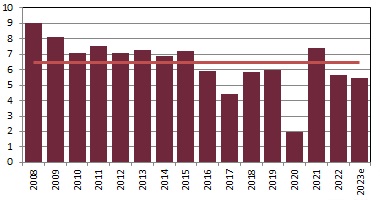
Uzbekistan GDP Growth Rate (%)
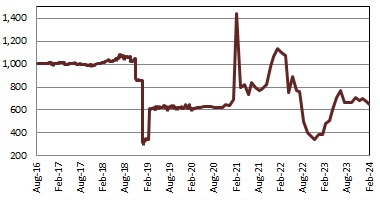
Uzbekistan Stock Exchange Index
Stock Market:
Founded on 8th April 1994, the Tashkent Stock Exchange was established for the privatisation of state-owned companies, which were reorganised and partially privatised throughout the 1990s. This led to a broad shareholder base and better wealth distribution amongst the population, relative to other ex-Soviet satellite countries. The Tashkent Stock Exchange lists 85 ordinary shares of companies and 38 preferred shares with a combined market capitalisation of USD 9.7 billion as of January 2026, and had its first-ever IPO, Kvarts on 11th April 2018. Additionally, about 677 companies are listed on the OTC-market (previously Elsis-Savdo), and including preferred shares, there are about 862 different securities admitted for trading as of January 2026.
Useful Links:
Republican Stock Exchange «Tashkent» website: www.uzse.uz
UZBEKISTAN
Population: 38m
5 Year average GDP growth: 7.3%
- Stable country undergoing generational economic reforms, spurned by new president
- Large, young and underleveraged consumer class
- Strategically located to become the “factory” of Central Asia
- Significant natural resource base: natural gas, cotton, gold, copper: largest gold mine in the world